Showing posts with label London 2013. Show all posts

Sunday, March 29, 2015

The alienating realism of Under the Skin


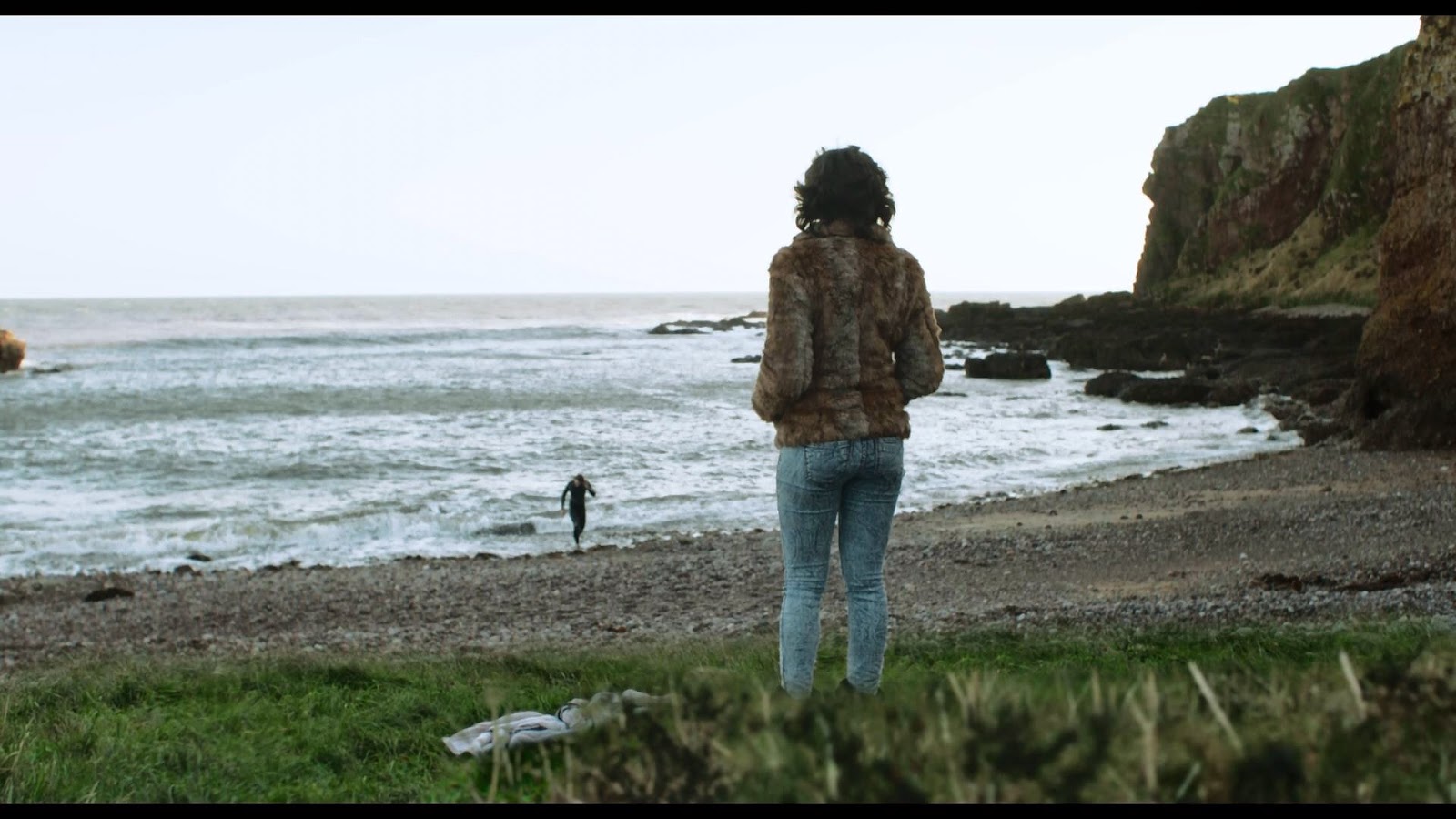
Jonathan Glazer’s Under the Skin polarised critical and popular opinion from the moment it hit the festival circuit in the autumn of 2013. About twelve months later, the film was hailed by many critics as one of the best of the year and it made an appearance in numerous top 10-lists. The lose adaptation of Michel Faber’s 2000 novel stars Scarlett Johansson as an unnamed alien preying on humans of the male variety in Scotland. During its difficult, decade-long production history, the project went through numerous iterations and transformations. The final result was produced for a relatively modest £8 million and takes an almost experimental approach to narrative filmmaking. In the following paragraphs, I will show how Under the Skin is innovative on a technical as well as a textual level in a number of ways, particularly in regards to its attitude towards realism.

One of the most interesting aspects of the film is its much debated use of non-professional actors and of hidden cameras. During the shoot, an almost unrecognisable Johansson would drive around the streets of Glasgow and strike up conversations with unknowing passers-by. In order to capture these scenes, the filmmakers installed ten small digital cameras throughout the driver’s cabin. All ten angles were filmed at the same time. Jonathan Glazer would meanwhile give instructions to Scarlett Johansson via an earpiece. This required some inventive work from the technical department (the cameras had to be inconspicuous) and the editor (due to the enormous amount of footage shot simultaneously). The concept itself is obviously nothing new. In an article for The Dissolve, Matt Singer discusses the history of the hidden camera-technique from 1948’s Candid Camera to more recent examples such as Borat (Larry Charles, 2006) or Great World of Sound (Craig Zobel, 2007). The main differences between Under the Skin and its predecessors are genre and purpose. The vast majority of Singer’s examples are comedies, frequently made for television. Others include reality-TV and investigative documentaries. Glazer takes this gimmick and applies it to narrative, dramatic cinema. In the process, the director asks fundamental questions about the nature of the medium. The concept of realism and the desire to depict reality on screen have occupied cinema and the discipline of film studies since their inception. Many current directors use handheld cameras and/or long takes to convey an illusion of the real, but Glazer erases (or at least blurs) the line between truth and fiction. During her travels through Scotland, the alien encounters a series of characters that are played by a mixture of amateur and professional actors. Crucially, the objective gaze of the camera remains neutral and the audience often can’t distinguish between the two; between naturalism and performance. The only person who is clearly acting is Scarlett Johansson. The star plays on her image as a glamourous Hollywood celebrity. Like the extra-terrestrial protagonist, she looks completely out of place in the rough, gritty environment of Scotland. Performance style and stardom are thus used as a means to make Johansson’s character stand out even more from her surroundings.

Under the Skin establishes an original form of realism through the use of hidden cameras, which Glazer exploits in a truly innovative manner. The film is defined by the juxtaposition of two polar opposites; as Jonathan Romney put it in Sight & Sound: ‘the surreal and the very concretely real.’ Glazer combines the real life people, landscapes and locations with fantastical images and Mica Levi’s mesmerising soundtrack. During the eye-creation sequence in the beginning and the devouring-scene later on, the imagery even veers into the abstract. We see a viscous liquid flow towards a bright, red rectangle followed by several seconds of flashing lights and incomprehensible images. The realism of Under the Skin does not attempt to draw the audience into the narrative or to highlight a particular social issue. On the contrary, it arguably takes on Brechtian qualities and serves as an alienation device. Looking at humanity from an outside (an alien) perspective is one of the main themes of the film. The alien struggles to understand, and later emulate, human behaviour, and as spectators, we empathise with her confusion. The environment of the shopping centre Johansson visits in an early scene is extremely real and familiar to most audiences, yet the scene strikes us as artificial and strange. After seeing the alien hesitantly pick out an outfit, there are several brief, voyeuristic shots of women having make-up applied. This suggests that their behaviour is just as absurd and unnatural as the alien’s. Another sequence, in which Johansson follows a man into a nightclub, works in a similar fashion. She is ushered onto the dancefloor by a flock of excited young women who communicate through indistinguishable chatter. Partying seems like a strange, exotic ritual throughout the entire sequence. Both these scenes were shot with hidden cameras at real life locations. Glazer thus manages to subvert the traditional meaning of realism and uses it to provide us with an outside perspective. In Under the Skin, the screen is not like window, but like fairground mirror rendering a skewed image of ourselves.


Read my original review of Under the Skin here.

Sunday, March 30, 2014

Double take: Richard Ayoade does the double with The Double

“You are pretty unnoticeable, aren’t you? You’re a bit of a non-person!” – This is how Simon James (Jesse Eisenberg), our protagonist is described by one of his co-workers. To his face. He admittedly has got a point: no one seems to care about or even notice Simon. He works a boring office job. He doesn’t receive credit for his work. Hannah (Mia Wasikowska), the girl he is in love with, ignores him. Even the office elevator seems to hold a personal grudge against him. He is all but invisible to the world around him.


Then, inevitably, someone else turns up and steals his dreams from under his nose. Less inevitably, this person is Simon’s exact doppelgänger. James Simon (Eisenberg again) looks and sounds exactly like Simon James (the difference being that the former is confident and imposing), a peculiarity which no one seems to notice. Slowly, James becomes everything Simon wants to be, manipulating and humiliating him in the process.

I recently saw The Double for the second time at a preview screening, courtesy of the lovely folk of the Duke of York’s Picturehouse in Brighton. The film very much holds up on second viewing. It is loosely based on a novella by Dostoyevsky, but director Richard Ayoade (Submarine) replaces the setting in rural, 19th century Russia for a dark, moody fantasy-world, not too dissimilar to Terry Gilliam’s Brazil. It is a subjective environment; we look at the world through Simon’s eyes. It looks like a futuristic Soviet union and is shot in an almost expressionistic style, filled with sharp, contrasting shadows and striking lights. There is no daylight. Everything is a little odd: the songs are Japanese pop songs and there is a science-fiction cop-show starring Paddy Considine on TV. Like Simon, we can’t really make sense of it all.

While the visual style is in many ways a (skilfully assembled) hybrid of various cinematic predecessors (Gillam, Wes Anderson amongst others), it is through the comedy that Ayoade shines through. The humour, which ranges from morbid to silly, keeps the story going and prevents it from becoming too dark. We laugh at Simon’s misfortune, but thanks to Eisenberg’s performance, we never lose affection for the character, which could become pathetic in lesser hands. Chris O’Dowd, who hilariously cameos as a nurse, is worth a special mention.


The Double is a very peculiar, but intriguing film. Movies about introverted, lonely people are very difficult to pull off, but Ayoade manages to put an interesting spin on the story. It is consistently funny and appealing to look at. It may not be a masterpiece or a classic for the ages, but it confirms Richard Ayoade as one of the most promising and skilful young filmmakers working in British cinema today.

Rating: ★★★★

Thursday, March 27, 2014

Under the Skin

The first time I heard of Under the Skin was at the Venice film festival. I was talking to a British journalist, who works for FRED film radio and the BBC: “This is one of the worst films I have ever seen!” She went on and on: “I don’t know how this got made. What was Jonathan Glazer thinking?” Later that day, the film was booed by a large part of the audience at the gala screening with Jonathan Glazer and Scarlett Johansson in attendance. Others, including many British critics, came out of the screening correctly singing its praises.

Unfortunately I did not manage to see the polarizing film in Venice. I didn’t manage to see it in London either. I had to wait until it was released in the UK last week. At the time of writing I have seen it twice within 5 days, and I’m strongly considering going again. It is that good.


An alien (Scarlett Johansson) drives around Glasgow in a white van. Her (or its?) mission is to pick up random men and lure them back to her house (spaceship? space?) where they are then, for the lack of a better word, “consumed” by some sort of extra-terrestrial sludge. If this does not sound strange enough, know that large portions of it were filmed with hidden cameras, using unknowing passer-by’s as actors. It is difficult and unnecessary to say more about the story, so I will leave it at this.

The most impressive thing about Under the Skin is the way in which Jonathan Glazer combines the gritty hyper-real and the slick, crazy surreal almost seamlessly through superb visuals and sound design. Comparisons have been made with Lynch, Kubrick or von Trier, but none of them are really satisfactory. Under the Skin is something different, a true original. Every image looks and feels right. Mica Levi’s mesmerizing, creepy score helps to join the different elements and creates a haunting atmosphere throughout the film. The importance of the music cannot be overstated and the recurring three note theme will burn itself onto your brain and haunt you in your worst nightmares.

What is it all about though? The answer to this depends on the spectator. If you are looking for answers and explanations, you will be disappointed. Glazer merely presents this story and encourages the audience to think. There are several ways to look at it. It could be a film about the strangeness of human behaviour. Seeing an alien imitate humans, clearly not understanding them, makes us realise how weird we must look to an outsider. In this sense, the film has the same effect as repeating the same word over and over, until it feels completely unnatural. There also is an interesting gender discourse within the film.

Scarlett Johansson’s performance is nothing short of brilliant; possibly the best of her career. It is an extremely physical achievement. She uses her entire body in a way she has never done before. Every gesture is full of meaning. She always seems slightly uncomfortable in her skin in the way she holds herself, slightly dropping her shoulders, the arms dangling loosely at her side. It is an extremely difficult performance to pull off, because her character’s main function is to be looked at. She is a passive character and she is the subject of her victims’ gaze, of the camera’s gaze and finally of her own gaze. About halfway through, she catches a glimpse of herself in a mirror and starts to develop an interest in her body. Mirrors are a recurring element, emphasizing the “fakeness” of her body. This stands in complete contrast to her character Spike Jonze’s Her (in which she was miscast), in which she also played a non-human form of intelligence with a desire to become human. Unlike the bodiless operating system Samantha, the unnamed alien of Under the Skin is primarily defined through her physical presence.


Under the Skin is a film that is very difficult to describe and impossible to put into a fixed category. It contains genre elements (science-fiction, erotic thriller, social realism) without belonging to any of them. Watching it is a strange, hypnotic experience and I haven’t been this captivated and fascinated by a film since Ming Liang Tsai’s Stray Dogs. Films like this remind me, why I love cinema so much. It will however divide people. Many will hate it, many will not understand it. In my opinion, it is the best film of 2014 so far.

Rating: ★★★★★

Also on cine-jambalaya: The alienating realism of Under the Skin

Tuesday, February 18, 2014

Review: Nebraska

Some movies simply need time to have a full impact. Alexander Payne’sNebraska was the first movie I saw at the London Film Festival, which is perhaps the worst possible timing. I really enjoyed the film, laughed all the way through and was touched by it. However, only one hour after the lights went up after it finished, I was sitting down for the next film, the second of four of the day. 10 days and 30+ movies later, when it came to pick my top 10 films of the festival, Nebraska wasn’t one of them. While I had not forgotten about it, I judged it to be light and less memorable than other films.
About a month later, when I was picking my favourite films of 2013, Nebraskamade the initial long list. Clearly there was something about it that stayed on my mind. Then Nebraska was finally released in UK theatres, and with it came the usual articles, interviews and reviews. After reading Matt Micucci’s excellentreview of the film, I finally did what I had neglected to do after seeing it: I thought about it. Well over two months had passed since I had seen the film, and yet more and more details came back to me. Another month later, and I still can’t stop thinking about it, which is why I have decided to write about it. Sometimes, it just takes a little time to fully appreciate a film.
image
Woody is an old, retired mechanic on the brink of senility. The film’s opening shot shows him walking on foot next to the highway and being stopped by the police. He has received a letter promising him a million dollars if he shows up in Nebraska, and is determined to walk the 700 miles from his home in Montana to claim his prize. Despite everyone repeatedly assuring him that the million dollars does not exist and that the letter is a marketing scam, Woody refuses to (or is unable to) see sense. Finally his son David takes pity on him and agrees to drive him to Nebraska. Together they embark on a journey which has no pot of gold at its end. On the way, they stop in Woody’s home town, where the supposed millionaire quickly becomes a local celebrity. 
First of all, the film looks absolutely beautiful. Payne, who was born in Nebraska, has an eye for rural America like few other directors. His decision forNebraska to be in black and white was an inspired one and the visuals give the film simultaneously a stylised looked and a certain sense of realism. The cast is also outstanding. Stacy Keach and June Squibb (as Woody’s ceaselessly bickering wife) shine in great, scene-stealing roles, but at the heart of the film are Bruce Dern and Will Forte. Dern’s performance has been rightly receiving a lot of attention, winning the best actor award at Cannes, but Forte (primarily known as a comedian on SNL) is the biggest surprise. He takes a very difficult role of the quiet, anxiety-ridden son and makes it his own; first-class under-acting.
Payne not only has an eye for the look of rural America, but he also has an ear for the people of rural America, their character and their language. Even though he did not write the script for Nebraska himself, it feels very much like an Alexander Payne film (one might call it Payne-ful), balancing drama and a particularly warm and human sense of humour, which has distinguished his films in the past.  Woody’s home town and his family are crowded with quirky, unique characters and the small town politics play out perfectly.
The most interesting thing about Nebraska is however the father-son relationship at the centre of it all. Woody has not been the best father to David, prone to have a drink or two; but there is clearly a lot of love, even if he struggles to express it. David is unsure how to feel about his dad, he desperately wants to love him, but doesn’t know how or why. The journey to Nebraska is also a journey for David into the unknown realms of his father’s past. Meeting people from his father’s youth helps him understand the old stubborn man he is travelling with, and slowly they start to reconnect. It is this troubled, affecting relationship that remained with me all this time and which makes Nebraska my favourite Alexander Payne film.

Rating: ★★★★

Top 13 of ‘13: 1. Inside Llewyn Davis

image 
The most impressive thing about the Coen brothers these days is that they are seemingly effortlessly brilliant. Like Luis Suarez and nutmegs, they make filmmaking look straightforward and easy. Inside Llewyn Davis, their tale of the Greenwich Village folk scene of the early 1960s, slots in perfectly in their filmography, closest in tone to Barton Fink and The Man Who Wasn’t There.
The movie opens with a close-up of microphone in front of a dark background. A title has told us where we are: The Gaslight Café, 1961. Guitar music is playing and a male voice starts singing: “Hang me, oh hang me; I’ll be dead and gone…” Even before we see our protagonist, we know exactly where we are. It’s unusual to talk about the music first in a film review, but the soundtrack of Inside Llewyn Davis is not only brilliant, but also integral to the story. Most of the songs are performed live and in full length by the characters, almost making it a concert-movie of sorts. Enlisting the help of regular collaborator and music legend T-Bone Burnett, the Coens have assembled (there is only one original song) one of the best soundtracks in years.
The film tells the story of the failed (or rather failing) folk singer Llewyn Davis. After losing his singing partner, Llewyn is struggling to make it as a solo artist. Broke (he can’t even afford a winter coat) and homeless, he treks from couch to couch, until he runs out of friends and starts at the beginning. We are never sure whether Llewyn is a misunderstood musical genius or just a pretentious failure, but he sure thinks he is the former. He is rude, selfish and takes the charity of others for granted; yet somehow strangely likeable. Credit for this has to go to Oscar Isaac, who delivers a superb, understated acting and singing performance, completely embodying this character. He is never caught acting.
As usual with the Coens, an abundance of eccentric and funny supporting characters pop in and out of the story. Highlights include Justin Timberlake and Carey Mulligan playing the musician-couple Jim and Jean, John Goodman, who is finally reunited with the Coen brothers for a fifth time as the hilarious, drug addicted jazz musician Roland Turner, and a ginger cat which Llewyn chases through New York.
The structure of Inside Llewyn Davis puts an ironic, extremely coenesque twist on the classic road movie (there even is an actual road trip to Chicago in the middle of the film). Llewyn is constantly travelling from place to place, meeting different characters. Unlike Bruce Dern in Nebraska, Alexander Payne’s great road movie, Llewyn’s journey has no goal, and our hero keeps going around in circles, returning to where he has been before.  It’s the story of a loser who remains a loser.
While the story, when you think about it, is quite bleak, the tone is surprisingly warm and affectionate, not only due to the music, but also due to the characters. The dialogue is filled with an ever so slightly strange humour and wit, some of which you won’t notice the first time around, rewarding multiple viewings. The period is beautifully realised and cinematographer Bruno Delbonnel almost makes you forget that Roger Deakins was busy shooting Skyfall.
image
Making sense of it all may be difficult and if closure is what you’re looking for, you’re going to be disappointed. Asking more questions than it answers, Inside Llewyn Davis is an almost nihilistic, empty masterpiece, yet full of warmth and humour. It’s a film about how following your dreams might not always be the best idea, it’s a film about music, it’s a film about grief and responsibility; it’s simply a film you have to see.

Top 13 of ‘13: 8. Gravity

The set-up for Gravity is simple: Sandra Bullock and George Clooney are two astronauts who are lost in space after an accident involving satellite debris and are struggling for survival. Essentially, it is a B-movie with a budget. Its story is thin and its characters are even thinner. The dialogue is frequently clunky, melodramatic and unbelievable. George Clooney plays a mixture of Buzz Lightyear and himself in the Nespresso ads.
Gravity works nonetheless is because it is aware of this and keeps things simple. It never tries to be anything more than spectacle, a quick, 90-minute thrill ride. It’s not about saving the world; it’s about surviving in the most hostile environment a human can find himself in. The reason a B-movie with a budget is one of the best films of the year is not a lack of good films, but the amazing things Alfonso Cuarón has achieved with this budget. The visual effects are of an unprecedented quality; even the 3D is great.
The film’s unbroken 13-minute opening shot is the single most spectacular action-scene of the year by some distance, and the action in general is simultaneously absolutely gorgeous as well as frightening and intense. While more of a ride, a spectacle than an actual film (some people have dismissed it as a mere technical exercise, which is very harsh in my opinion), Gravity is one of the most cinematic experiences of the year, demonstrating Alfonso Cuarón’s craftsmanship as a great director and should be seen by everyone, in 3D, on as big a screen as possible.

Top 13 of ‘13: 13. Saving Mr Banks (+ rules)

Rules
In order to make this list as relevant as possible and to facilitate my selection, I have decided on certain restrictions when choosing my films of the year. First of all, I will obviously limit myself to films which have seen. While I managed to catch most major 2013 releases, I missed some films which might have made my top 13 (i.e. A Field in England, Upstream Color,  The Act of Killing, The Smurfs 2). Another condition is that they have to have had a general 2013 release in one of the two countries in which I usually go to the cinema: the UK and Luxembourg. This eliminates a number of films I’ve seen at festivals such as Stray Dogs, 12 Years a Slave or The Zero Theorem. Furthermore, films which were part of last year’s awards race, but not released until early 2013 (Zero Dark Thirty, Les Misérables, No) will not be taken into consideration, as they feel very much like 2012 films.
Honorable Mentions 
About Time
Behind the Candelabra
Despicable me 2
Frances Ha
La grande bellezza (The Great Beauty)
The Hunger Games: Catching Fire
Nebraska
Le passé (The Past)
Pacific Rim
Philomena
The Selfish Giant
Le temps de l’aventure (Just a Sigh)
Tian zhu ding (A Touch of Sin)
You’re Next
La Vie d’Adèle (Blue is the Warmest Colour) 
imageFor some inexplicable reason, I had never seen Disney classic Mary Poppins (a mistake which has been duly corrected since) nor read any of the books, before seeing John Lee Hancock’s Saving Mr Banks, the closing film of the 57th BFI London Film Festival. Aside from knowing the basic premise of the story (a magical nanny arrives with her flying umbrella in an ordinary London family) and some vague memories of the songs, I did not know anything about the 1961 film. Fortunately this is not mandatory (though highly recommended) in order to feel the delight of Saving Mr Banks, which tells the story of the making of Mary Poppins, or rather the story of the author of the source novel P.J. Travers.
In a way, Saving Mr Banks is two movies squeezed into one. Firstly, there is the story of the famous writer P.J. Travers (Emma Thompson), who travels to Los Angeles in order to oversee the Hollywood adaptation of her most famous work for Walt Disney (Tom Hanks). Extremely protective of her work and reluctant to let go of her work, Travers, who had script-approval, was extremely difficult to work with, making impossible requests. At one point, she even demanded that the colour red was not to be used in the film. This narrative is intertwined with flashbacks, which show a young Travers (Annie Buckley) growing up in rural Australia with an alcoholic father (Colin Farrell) and a mother unable to cope with the situation (Ruth Wilson).
These flashbacks are rather bleak and depressing, even though Colin Farrell manages to bring some warmth to these sequences. While they are genuinely moving and important to the main story, as they explain P.J. Travers’ stubbornness,   the flashbacks are arguably the weakest part of the film. In fact, they feel a bit too separate from the main plot, almost like a different film, and they take longer than it takes us to understand their message.  That said, having a slightly overlong, tragically moving backstory as the biggest weakness is not too shabby.
The main story on the other hand is an absolute feel-good delight, in the classic Disney fashion. The only thing that distinguishes it from a classic Disney film is that its target audience is slightly more grown-up. It’s funny, it’s moving, it’s comforting, it’s everything you want from a Disney film and it has very few rough edges. Tom Hanks is perfectly cast as Walt Disney. He has this child-like, innocent quality which suits the part. As for Emma Thompson, I could easily write this entire review about how brilliant she is. She is, to keep it short, supercalifragilisticexpialidocious and more. It is very much her film (Hanks is more of a supporting actor), and she brings incredible warmth to a character which starts out as grumpy, miserable and annoying; and when she starts being won over, I wasn’t the only person in the audience who suddenly had “something in their eye.”
Saving Mr Banks is an absolute must see for fans of Mary Poppins (according to the director and screenwriters, there are numerous references and in-jokes for fans of the classic to discover).Unashamedly moving and feel-good, you will walk out of the cinema with a huge grin on your face, humming “Let’s go fly a kite”
PS: I also want to mention a beautiful subplot which involves P.J. Travers befriends her driver, played by one of my favourite actors Paul Giamatti, which shows the quality of Kelly Marcel and Sue Smith’s script.
image

Cine-City film festival: We Are the Best!

Published on The Badger website: http://www.badgeronline.co.uk/review-best/ 
We Are the Best!, which screened at the Duke of York’s after a lengthy festival run, including Venice and London, is one of the highlights of this year’s CineCity film festival. Written and directed by the Swede Lukas Moodysson, who brings us a wonderful tale about growing up, friendship and punk music, it will transfix teenage and adult audiences alike.
Bobo and Klara are thirteen years old and best friends in 1983 Stockholm. They are passionate punks and rebels, cutting their own hair short (Klara has a glorious mohawk) and listening to Swedish punk music. One day, they decide to form their own punk band and as Jack Black’s School of Rock character would put it: “Stick it to the man!” Full of enthusiasm, they write a song about their horrible P.E. teacher (chorus: “I hate the sport! I hate the sport! I hate hate hate the sport!”) and start rehearsing at the local youth centre. The problem however is that they don’t know how to play instruments. Therefore, they enlist the help of guitar-playing loner Hedwig, who fortunately also hates sports.
This is not a film about the discovery of the next big punk stars, but rather a character study of these three girls who are entering puberty. There are very few grown-ups and the children take centre stage. A difficult relationship and disconnect with the parents, a crush on an older boy and first experiences with alcohol are some of the typical teenage anxieties Bobo, Klara and Hedwig go through.
The reason that We Are the Best! works is because you enjoy listening to their lively discussions and generally spending time with these girls. Lukas Moodysson clearly has a lot of affection for these characters and this translates to the audience, creating a very mature and balanced portrayal of adolescence. The three young actresses are excellent, by the way. Crucially, the film, while taking a grown-up point of view, is not patronising at all towards the girls, taking them and their anxieties seriously at all times and avoiding cute for cuteness’ sake.
That said, it is much more fun than this review has made it sound so far. The tone is constantly light-hearted and there are numerous humorous (try saying that out loud) moments, particularly when they are discussing boys or God (Hedwig is a Christian, whereas Klara is a convinced atheist). Moreover, the finale is a perfectly timed, heart-warming, low-key conclusion to this very good film.

Rating: ★★★★

Review: Saving Mr Banks (London, closing film)

For some inexplicable reason, I had never seen Disney classic Mary Poppins(a mistake which has been duly corrected since) nor read any of the books, before seeing John Lee Hancock’s Saving Mr Banks, the closing film of the 57th BFI London Film Festival. Aside from knowing the basic premise of the story (a magical nanny arrives with her flying umbrella in an ordinary London family) and some vague memories of the songs, I did not know anything about the 1961 film. Fortunately this is not mandatory (though highly recommended) in order to feel the delight of Saving Mr Banks, which tells the story of the making of Mary Poppins, or rather the story of the author of the source novel P.J. Travers.
In a way, Saving Mr Banks is two movies squeezed into one. Firstly, there is the story of the famous writer P.J. Travers (Emma Thompson), who travels to Los Angeles in order to oversee the Hollywood adaptation of her most famous work for Walt Disney (Tom Hanks). Extremely protective of her work and reluctant to let go of her work, Travers, who had script-approval, was extremely difficult to work with, making impossible requests. At one point, she even demanded that the colour red was not to be used in the film. This narrative is intertwined with flashbacks, which show a young Travers (Annie Buckley) growing up in rural Australia with an alcoholic father (Colin Farrell) and a mother unable to cope with the situation (Ruth Wilson).
These flashbacks are rather bleak and depressing, even though Colin Farrell manages to bring some warmth to these sequences. While they are genuinely moving and important to the main story, as they explain P.J. Travers’ stubbornness,   the flashbacks are arguably the weakest part of the film. In fact, they feel a bit too separate from the main plot, almost like a different film, and they take longer than it takes us to understand their message.  That said, having a slightly overlong, tragically moving backstory as the biggest weakness is not too shabby.
The main story on the other hand is an absolute feel-good delight, in the classic Disney fashion. The only thing that distinguishes it from a classic Disney film is that its target audience is slightly more grown-up. It’s funny, it’s moving, it’s comforting, it’s everything you want from a Disney film and it has very few rough edges. Tom Hanks is perfectly cast as Walt Disney. He has this child-like, innocent quality which suits the part. As for Emma Thompson, I could easily write this entire review about how brilliant she is. She is, to keep it short, supercalifragilisticexpialidocious and more. It is very much her film (Hanks is more of a supporting actor), and she brings incredible warmth to a character which starts out as grumpy, miserable and annoying; and when she starts being won over, I wasn’t the only person in the audience who suddenly had “something in their eye.”
Saving Mr Banks is an absolute must see for fans of Mary Poppins(according to the director and screenwriters, there are numerous references and in-jokes for fans of the classic to discover).Unashamedly moving and feel-good, you will walk out of the cinema with a huge grin on your face, humming “Let’s go fly a kite”
PS: I also want to mention a beautiful subplot which involves P.J. Travers befriends her driver, played by one of my favourite actors Paul Giamatti, which shows the quality of Kelly Marcel and Sue Smith’s script.


Rating: ★★★★

Review: Ida (London)


Ida [trailer] is UK-based director Pawel Pawlikowski’s first film made in his native Poland. Thus it is only fitting that his work is presented in his adopted home at the London Film Festival after taking top honours at the Gdynia Film Festival. Selected for the official competition, Ida is a slow, low-key, old-fashioned movie about identity, religion and dealing with a dark past. Shot in beautiful black and white and a nowadays rarely used aspect ratio of 4:3, the film is set in the early 1960’s in Poland and has a particular sense of this period, in which the shadow of the war was still ubiquitous.
The plot revolves around Ida (newcomer Agata Trzebuchowska), a young woman who grew up in a monastery and is about to take her vows to become a nun. Ida is an extremely quiet, timid young girl, with a strong sense of right and wrong. In many ways, she is the epitome of innocence (which is perfectly captured by Trzebuchowska).  Before committing her life to God, Ida is encouraged to contact her only living relative, her aunt Wanda (Agata Kulesza). Wanda’s personality is the exact opposite of Ida’s. She is openly emotional and not afraid to express her opinions. Her profession - she is a judge - also contrasts with Ida’s vocation as a nun. Together, the pairing decides to investigate the disappearance of Ida’s parents, who were Jewish fugitives during the war.  Wanda had clearly delayed this task as long as possible, afraid of the truth. Rather than focus on the investigation and the mystery of what happened, Pawlikowski prefers to explore the odd relationship between the two lead characters, which both have demons to deal with. For the first hour, the film works really well. The chemistry between the lead characters who grow closer and closer is tangible as Ida confronts an identity crisis (is she a Catholic or a Jew?) and Wanda deals with her own wartime past.  It is a real shame that the final part lets the rest of the movie down, as it becomes slightly melodramatic and predictable.
The real star of Ida is however the cinematography. Pawlikowski and his DP Lukasz Zal chose to convey meaning and build the characters through images rather than the sparse dialogue and come up with extraordinary images. Every shot seems meticulously composed, frequently using unusual camera angles and framings. Furthermore the photography, the black and white contrast, the different shades of grey, are gorgeous and make Ida a cinematic experience which ought to be seen on the big screen.

Top 10 films of the BFI London Film Festival

I have seen a grand total of 47 films from the programme of the BFI London Film Festival, either at the LFF, in Venice or elsewhere. While there are many films I missed (Gravity, Labor Day, Only Lovers Left Alive…), here are my very personal top 10 films of the ones I have seen (at least at the moment I am writing this). The overall quality of the films has been excellent and bringing it down to 10, or even 17 if you count the honourable mentions, was not easy. They are admittedly mostly the obvious choices, but they are obvious choices for a reason:
10.Felix (directed by Roberta Durrant)
This small South-African children’s film about a boy who is desperate to follow in his father’s footsteps and become a jazz saxophonist was a joyous surprise. Made with craftsmanship, passion and a lot of heart, this film will make you smile for hours. I hope this finds the audience it deserves.
9. Ida (directed by Pawel Pawlikowski)
 
Pawel Pawlikowski first Polish film won best film in the Official Competition of the festival. Filled with beautiful, striking visuals, Ida tells the touching story of two women, who face personal issues and are haunted by the legacy of World War II. Debutant Agata Trzebuchowska impressively carries the film with a great, low-key performance. 
8. Saving Mr Banks (directed by John Lee Hancock)
Saving Mr Banks is half a good film, half a great film about the author of Mary Poppins (and Walt Disney). Plays like a classic Disney film: great humour and even greater sentiment. Emma Thompson, one of the truly great actresses, is as good as she’s ever been as a character which could have become annoying in lesser hands. Made laugh, made me cry, and then cry some more.
7. Philomena (directed by Stephen Frears)
This is a true-life tale of a woman who was forced to give away her son and decides to look for him 50 years later. Frears strikes about  the perfect balance between drama and comedy, anchored by strong performances by Dame Judi Dench and Steve Coogan (who should be Oscar-nominated for this performance, but won’t). Take your mum, your gran, yourself – everyone to see this. 
6. Le Passé  (directed by Asghar Farhadi)
The first French-language picture of Iranian director Asghar Farhadi (A Seperation) is a very tough, moving family drama. It’s superbly written, has assembled a fantastic ensemble cast (Ali Mosaffa, Pauline Burlet and Bérénice Bejo being the standouts) and feels much shorter than its 130min running time.
5. The Zero Theorem (directed by Terry Gillam)
Terry Gilliam, one of cinema’s most original voices, finally returns with The Zero Theorem. While indubitably not one of his best, I don’t get the negative reactions. All the usual Gilliam touches are there: amazing visuals, crazy production design, and little in jokes. Most importantly though, the film contains a scene in which a bald Tilda Swinton starts rapping for no reason.
4. All Is Lost (directed by J. C. Chandor)
Robert Redford on a boat. No dialogue, no back-story, simply Robert Redford on a boat, against the elements. One of the best thrillers of the year, All Is Lost is an intense, relentless ride. I was fully immersed into it, I could almost feel the sea wind in my hair. Redford should win the Oscar for this.
3. Why Don’t You Play In Hell? (directed by Shion Sono)
One of the most original and craziest films I’ve seen in a long time. Combining amateur filmmaking, teen romance, the Japanese mafia and an extremely catchy toothpaste jingle, all hell breaks loose in this ultra-violent, exploitation B-movie. Blood and limps flying everywhere, this is a big bowl of fun.
2. 12 Years a Slave (directed by Steve McQueen)
Steve McQueen has now made 3 brilliant films in 3 attempts and he should make some room on his awards shelf. As should Chiwetel Ejiofor, who carries the film with a terrific, tortured central performance. Furthermore, he is surrounded by an incredible supporting cast (Giamatti! Cumberbatch! Fassbender! Pitt!, and scene stealing newcomer Lupita Nyong’o). A tough, harrowing experience, which is based on the autobiography of Solomon Northup, who was kidnapped and spent 12 years in slavery, is the best film about this part of history I have seen.
1. Inside Llewyn Davis (directed by Joel and Ethan Coen)
The Coen brothers have done it again. Set in the New York folk music scene in the early 1960s, we follow struggling musician Llewyn Davis, hopping from couch to couch. The film plays like a road movie, in which the main character doesn’t complete a journey, but keeps moving in circles and ends up in the same places. The soundtrack, produced and arranged by T-Bone Burnett is a thing of perfection.
Honourable mentions:
The Selfish Giant (dir Clio Barnard): moving British drama in the style of Ken Loach
The Double (dir Richard Ayoade): Jesse Eisenberg vs Jesse Eisenberg
Jeune & Jolie (dir François Ozon): a young girl discovers herself through her sexuality
Captain Philips (dir Paul Greengrass): gripping, intense Somali-pirate thriller
The Spectacular Now (dir James Ponsoldt): interesting take on the teen movie with strong characters
The Armstrong Lie (dir Alex Gibney): documentary about the doping scandal surrounding cycling legend Lance Armstrong
Milius (dir Zak Knutson, Joey Figueroa): big bowl of anecdotes about Hollywood legend John Milius

Review: Here Be Dragons (London, as featured on Cineuropa)

This review was featured on well-known movie website Cineuropa.
image
Warning: There are no dragons in this movie!
As part of the Documentary Competition section of the 57th BFI London Film Festival, Here Be Dragons, the latest work by British “filmmaker, writer, wanderer” (according to his own twitter bio) Mark Cousins (whose The Story of Film should be a mandatory viewing for all film students) celebrated its European premiere in the presence of the director and producer Don Boyd. Albania is a country, which most people from this part of the world, know very little about. Neither did Cousins two years ago, which is the reason Here Be Dragons exists. The title is a reference to ancient cartographers, who ignorant of what Albania was like, assumed that dragons must live there. When he was invited to visit Tirana and be a judge at the local film festival, Cousins, who is fascinated by being a complete alien to this society, decided to document his experience.
The result is a micro-budget (£10.000), extremely personal ‘’essay-film’’ in which Cousins immerses himself into the Albanian culture and history, still dominated by the legacy of the 41 year long communist reign of Enver (1944-1985). Shot in four days, edited in five, Cousins, rather than attempting to paint a complete picture of the country, films whatever captures his imagination, like an intellectual, well-researched travel film. He keeps himself out of the picture for most of the film, and communicates his thoughts through narration. He visits the local film-archives, an exposition of medieval icons; goes to the suburbs and talks to local children. A significant portion of the film is dedicated to the “pyramid of Tirana,” an astonishing ruin in the middle of the city. Built to honour Enver (it was designed by his daughter), abandoned after the fall of communism and now used as a TV station, the building and what it represents for Albania fascinates Cousins. The film however focuses on a five minute long rant, aimed at Enver, in which Cousins abandons his usual calm and considered tone (to a certain degree) to voice his frustrations and give his opinions on the problems Albania has faced in the past and present. During this, we see an ordinary road, a car drives away from the camera, people pass by. First forwards, then in reverse: the people come back, walking backwards, the car returns.
Here Be Dragons is not for everyone, and weather you enjoy it or not depends very much on your personal opinion of Cousins. He is clearly an extremely intelligent, thoughtful and cultured man, but his slow, monotonous narration takes getting used to. Moreover, while it would be easy to dismiss a man who describes the view out of his hotel window as a “Monet painting” as pretentious (which the film comes dangerously close to on several occasions), Cousins’ observations about the value of history, culture and memory are compelling, and the pleasure of Here Be Dragons lies in learning about an “alien” culture.

Rating: ★★★