Showing posts with label List. Show all posts

Thursday, December 18, 2014

Cine-jambalaya's favourite films of 2014 - part two

20-11. go back to part one

10. Paddington (Paul King)


Best... internet meme. Just google "creepy Paddington".

After Postman Pat and Pudsey the Dog: The Movie, almost no one expected Paddington's first big-screen outing to be any good, which makes the film's success as sweet as a delicious marmalade sandwich. It made me laugh, cry and reminded me why I fell in love with Great-Britain all those years ago. Family entertainment doesn't come much better than this. 

9. Pride (Matthew Warchus)


Best... scene of Imelda Staunton waving a dildo around.

Pride is part of the alternative heritage genre within British cinema alongside classics such as Brassed Off, The Full Monty, Billy Elliott or Made in Dagenham. Matthew Warchus' film doesn't have to hide from its predecessors. It has all it needs: an amazing true story, an important cause and a brilliant ensemble cast consisting of veterans (Nighy! Staunton! Considine!) and newcomers.

8. The Babadook (Jennifer Kent)


Best... title to say out loud.

At a time when most horror films rely on jump scares and splashes of bodily fluids, The Babadook provides a breath of fresh air from Down Under. First-time director Jennifer Kent sensitively explores grief and its consequences through the generic tropes of a ghost story. It is also creepy as hell (the first new film to genuinely scare me since The Impossible in 2012).

7. Stranger by the Lake/L'Inconnu du Lac (Alain Guiraudie)


Best... use of a single location.

As many critics pointed out when it was released, Stranger by the Lake puts the "cock" in "Hitchcockian". Set around a gay cruising spot in the south of France, this sexually explicit thriller lives off its brooding, menacing atmosphere and fantastic performances. The very best film of 2013 according to Cahiers du cinéma.


6. The LEGO Movie (Phil Lord and Chris Miller)


Best... and most annoying earworm.

With their one-two of The LEGO Movie and 22 Jump Street, Lord and Miller have had an amazing year. The pair are probably the funniest people working in movies today. They throw an almost overwhelming number of jokes, puns and references at the audience with an astonishing success rate. LEGO furthermore provides a surprisingly mature message: wild creativity is great, but sometimes you also need to follow the instructions. 

5. Calvary (John Michael McDonagh)


Best... beard. Just admire at its orange-white glory.

If Timothy Spall is my performance of the year, Brendan Gleeson is a close second. He brings such gravitas and serenity to his role as father James Lavelle. John Michael McDonagh's second feature is more thoughtful, but almost as funny as his debut The Guard (also starring Gleeson). The radical tonal shifts will sit uneasy with some people, but Calvary is a beast of a fillum. 


4. 20,000 Days on Earth (Iain Forsyth and Jane Pollard)


Best... depiction of wonderful Brighton town.

On one level, 20,000 Days on Earth is a documentary about the sensational Australian musician Nick Cave and his hometown Brighton. You get a real sense of Cave, his a fascinating character and his many, many inspirational ideas. On another level, it's a film about its own artifice. The directors put their subject in a number of pre-planned situations without scripted dialogue in order to find some form of "truth". 


3. Winter Sleep/Kis uykusu (Nuri Bilge Ceylan)


Best... drunken wittering.

This year's winner of the palme d'or at Cannes is a true behemoth of cinema. Ceylan evokes Chekhov, Dostoevsky, Shakespeare and Voltaire in a film which mostly features people discussing a variety of big subjects in dark rooms (but also features a exhilarating Anatolian landscapes). At the end of the 196 minutes, we understand the absurdity of most of the discussions you've heard.  

2. Boyhood (Richard Linklater)


Best... 

After last year's Before Midnight, the prolific director Richard Linklater once again finds himself at the runner-up position on cine-jambalaya's best-of list. After seeing Boyhood, which charts the life of a boy over a shooting period of twelve years, for the first time I was completely stunned. I can't think of a more truthful film about the experience of growing up in my generation (as long as you are a middle-class, white male at least).

1. Under the Skin (Jonathan Glazer)


Best... hidden cameras.

Describing Under the Skin with words is not an easy task, but it definitely lives up to its title and gets beneath the audience's membrane. Scarlett Johansson drives around Glasgow in a white van and gives the performance of her career until now as an unnamed being from a foreign world. Her attempts to understand the strangeness of human behaviour give us a rare opportunity to look at ourselves with the eyes of an outsider.

Tuesday, December 16, 2014

Cine-jambalaya's favourite films of 2014 - part one

It's nearly Christmas, which means that it's the time of the year when everybody comes together to let the world know their favourite films of the year. Cine-jambalaya is obviously no different and has complied the (probably) best list of them all. In a very strong year for cinema, choosing twenty films wasn't an easy task. This means that some great films didn't make the cut. I admired the incredibly ambitious but flawed Interstellar, enjoyed Jeremy Saulnier's reinvention of the revenge flick Blue Ruin and was taken by the heartbreaking self-sacrifice in Stations of the Cross. 2014 also saw the return of the "bonkers blockbuster" with Aronofsky's Noah and Besson's Lucy,both of which nearly made the list. So did a number of other amazing films, such as 22 Jump Street (Something cooooooool!), The Way He Looks, Cold in July, Lilting, Days of Future Past, The Grand Budapest Hotel and many others.

Before we begin, a quick note about the rules. This year, I have chosen to go with the cinematic release date in the magical kingdom ruled by the people of Great-Britain. Snowpiercer, Song of the Sea, Whiplash, Still the Water or A Girl Walks Home Alone at Night are therefore not eligible. I am also ignoring last year's awards contenders (Inside Llewyn Davis, 12 Years A Slave, The Wolf of Wall Street), even if they were released in the UK after the turn of the year.

20. Gone Girl (David Fincher)


Best... intensity of the "violent bit" (censored for spoilers).

David Fincher has a lot of fun adapting Gillian Flynn's twisted best-seller. He nails the darkly comedic tone of the source novel to near perfection, thus creating a truly fucked-up satire about relationships and marriage. Casting Ben Affleck as the highly punchable Nick Dunne was a stroke of genius.

19. We Are the Best!/Vi är bäst! (Lukas Moodysson) 


Best... cute song (I hate, hate, HATE the sports).

Three young and bored girls decide form a punk band, cut their hair and wave their small fists at authority. Set in 1983 Stockholm (five years after the first wave of punk faded away), this film is full of affection for its young protagonists and captures the fresh, rebellious DIY-spirit of the punk movement better than most cinematic works. Charm alarm. 


18. Only Lovers Left Alive (Jim Jarmusch)


Best... Tilda <3

A vampire movie made by American indie-darling Jim Jarmush starring Tilda Swinton, Mia Wasikowska and Tom Hiddleston? Sounds like a brilliant idea and it is. OLLA oozes style in its otherworldly soundtrack (composed by Jarmush's band SQÜRL) and the haunting beauty of its gritty Detroit locations. Possibly the director's best since Dead Man. 

17. Ida (Pawel Pawlikowski)


Best... use of the narrow 4:3 aspect ratio.

Pawel Pawlikowski returns to his native Poland for his latest feature Ida about a young woman confronted with her past. The film was the winner of the 2013 London Film Festival and could end up with a well-deserved Oscar nomination next year. The real star of Ida is the extraordinary cinematography implemented by DP Lukasz Zal.


16. Starred Up (David Mackenzie)


Best... Jack O'Connell breakout performance.

Within one year, Jack O'Connell has transformed from "that bloke from Skins" into one of cinema's most promising talents. His utterly convincing performance as a troubled, extremely violent prisoner in Starred Up justifies this status completely. The intensity and the brutality of this film gave me a slight feeling of discomfort in the stomach which is no mean feat.  

15. Dawn of the Planet of the Apes (Matt Reeves)


Best... apes on horses wielding machine guns!

I never understood the hype for 2011's Rise of the Planet of the Apes, but the Franco-less sequel won me over with Michael Giacchino's bombastic score and the surprisingly effective emotional beats. DOTPOTA is a rare blockbuster that is simultaneously intelligent, moving and a bit bonkers. Andy Serkis and Toby Kebbell rise motion-capture performances to yet another level.

14. Leviathan/Leviafan (Andrey Zvyagintsev)


Best... Vodka, vodka and more vodka.

The hugely critical Leviathan tackles big political issues (corruption, Putin, the political influence of the church) through the simple story of an ordinary man in northern Russia crushed by the authority of the local mayor. There is little to no hope for genuine happiness, so they drown their sorrows in a flood of vodka.

13. Life Itself (Steve James)


Best... bickering between Siskel and Ebert while taping.

Until his tragic death in April 2014 (before filming on the documentary was completed), Roger Ebert was arguably the most influential English-language film critic of the last century. His memoirs and interviews with his family and friends provide the framework for this quite standard, but incredibly moving picture about an extraordinary man and writer. Two thumbs up. 

12. The Zero Theorem (Terry Gilliam)


Best... scene featuring Tilda Swinton (<3) rapping.

Terry Gilliam is one of my favourite filmmakers. Even when he is not as his best, his work is reliably fascinating and original. A bald Christoph Waltz leads us into the odd, dystopian vision of The Zero Theorem. Gilliam makes the most of a visibly low budget and creates an inventive sci-fi which doesn't lack ideas. This film did not get the attention or the critical praise it deserved. 
11. Mr. Turner (Mike Leigh)


Best... breathtaking opening shot.

Mike Leigh had been working on his biopic of the celebrated British painter for more than a decade when he finally got the green light. This film achieves a seemingly contradictory feat: it's boring in a good way. The amusing 19th-century language and the beautiful cinematography make up for the lack of action. Timothy Spall mumbles and grunts himself to the year's best performance in the title role. 

10-1.: go to part two

Tuesday, October 21, 2014

Top 10: BFI London Film Festival 2014


As the BFI London Film Festival winds down and normality slowly returns to my daily routine, the time has come to reflect on the past days and pick my favourite films. I actually enjoyed most of the movies I saw in London, thus compiling this list wasn't easy. I did not take films that were featured in the equivalent article from Deauville (Whiplash, It Follows, A Girl Walks Home Alone at Night) or which I had seen already (Winter's Sleep, Mr. Turner) into consideration. There still was plenty to chose from and honourable mentions go to (in no particular order): The Wonders, Casa Grande, Wild, Mr. Kaplan, The President, X+Y, Madame Bovary, The Duke of Burgundy, Timbuktu, QPR 2-3 Liverpool FC and Margarita, with a Straw.   

10. Foxcatcher by Bennett Miller


Bennett Miller has sneakily established himself as one of  Hollywood's most capable directors. After Capote and Moneyball, he brings us a creepy character study of a spoiled rich man and an underprivileged wrestler. Foxcatcher will be billed as a sports movie, but it is anything but. The performances from Channing Tatum and Mark Ruffalo are fantastic, but it is very much Steve Carell's movie.

9. The Way He Looks (Hoje Eu Quero Voltar Sozinho) by Daniel Ribeiro


An unconventional love triangle is at the centre of this Brazilian coming of age-film. Blind teenager Leonardo discovers his (homo)sexuality, while rebelling against his caring parents and going through a rough patch with his best friend Giovana. Daniel Ribeiro brings a lot of tenderness to this film and explores desire without being able to fall back on the sexual gaze.


8. '71 by Yann Demange


Who could you trust in the streets of Belfast in the midst of the Troubles? There is no clear-cut answer to this question during this time of double-agents, traitors and ulterior motives. When a young British soldier finds himself isolated in the middle of this mess, he has to go to the limit in order to survive. '71 is a terrific, action-packed, violent debut feature, which further establishes Jack O'Connell as a star. 


7. Hard to Be a God (Trudno byt bogom) by Aleksey German


The inclusion of this film in my top 10 surprises even myself. It was my first LFF press-screening of this year's edition and I still don't know what to make of this three hour epic about human decadence. I have however been unable to shake it from my thoughts throughout the festival, which has to be a good thing. I tried to put the experience of watching Hard to be a God into words in my full review.

6. White God (Fehér Isten) by Kornél Mundruczó


A barking mad genre experiment from Hungary, which takes The Incredible Journey and adds Bourne-style chase sequences and plenty of gore. Meanwhile the film attempts to make an ambitious statement about racial discrimination, while also introducing a character study about growing up. And somehow it works. Read my full review here.

5. Leviathan by Andrey Zvyagintsev


If you try to do a drink-along viewing of this film, chances are, that you are either going to run out of vodka or die. Leviathan paints a grim picture of the current Russian regime through the example of a corrupt major in a small town in the north of the country. He will stop at nothing in his pursuit of a mechanic's estate. A gripping, human drama.

4. Phoenix by Christian Petzold


The central conceit of Phoenix is absurd (a husband doesn't recognize his wife after her return from Auschwitz), but Petzold somehow manages to pull it off by creating an almost surreal atmosphere, where anything seems possible. Nina Hoss carries the film with a brilliant performance. In the terrific finale, she rises like a phoenix from the ash. 

3. Far From Men (Loin des Hommes) by David Oelhoffen


According to the director, this is a film about the challenges of political commitment. Viggo Mortensen on the other hand describes it as a study of male friendship. Both are right, as the two ideas are combined intelligently in this slow-burn western. The stunning North African landscape and the gorgeous soundtrack by Nick Cave and Warren Ellis are like characters in the film.

2. Song of the Sea by Tomm Moore


Cartoon Saloon continues its success story after The Secret of Kells with the similarly brilliant Song of the Sea. Think Studio Ghibli, but from Ireland and with Brendan Gleeson's soothing voice. It's a refreshing work of art about magic, music and the acceptance of being ordinary. Probably the year's best animated movie. More praise for Song of the Sea can be found here.

1. Still the Water (Futatsume no mado) by Naomi Kawase


The inhabitants of Amami-Oshima, a small subtropical island south of the Japanese mainland, worship nature as if it were a god. This spiritual idea, that humans are always subordinated to the powers of Earth, is ubiquitous in Still the Water. At the heart of the film is an incredibly touching story about growing up and coming to terms with mortality. As Kyoko's mother is about to die, she finds her first love in the quiet boy Kaito. Kawase has made a slow, tender film, which is simultaneously moving and thought-provoking. Keep your eyes peeled for Still the Water. 

Sunday, September 21, 2014

Deauville Top 10 part two: 5.-1.

Part one: here 

5. Red Army by Gabe Polsky


Red Army is a sports documentary that is not really about sports. Ice hockey fans will know all about the exploits of the Soviet national team (which was actually a faction of the red army) during the 1980s, when the completely revolutionized the game with their free flowing passing strategy. The film takes the story of this team and the individuals behind it as a starting point for an examination of the cold war and of the to us often incomprehensible Soviet mentality. Why didn't any of the players give into the temptation of earning millions in the NHL and defect while travelling abroad? Why did they put up with the radical training methods of their coach (a former KGB man without a hockey background) for so long? The fear of authority and the power of the state were strong at that time, which still has repercussions in Russia today. At the forefront of the documentary are a series of interviews with the former captain of the team, Viacheslav “Slava” Fetisov. Fetisov is an intriguing character, who never reveals more than he wants to. He is brilliant at sidestepping the director’s more difficult, political questions (you will understand why by the end of the movie), which makes him a fascinating subject..


4. The Better Angels by A.J. Edwards


If you don't like the cinema of Terrence Malick, you probably want to give this film a miss. His fingerprints are all over A.J. Edwards' debut feature The Better Angels. Edwards, who has a long-standing professional relationship with Malick (he was an editorial intern on The New World and edited To the Wonder), seems to have picked up quite a bit from his mentor: the focus on emotion over narrative, the ideas of spirituality in nature, of idealized, angelic women and prominent organ music are all there. The film is supposedly about the childhood of Abraham Lincoln (I barely recognized Daniel Day-Lewis as a 10 year-old), but the future Honest Abe is more of an idea than a character. As a symbol for traditional American values, he looks at his family as a silent observer, sucking up all kinds of information. Learning about nature from his father (Jason Clarke) is equally important than the traditional forms of education, represented by the local school teacher played by Wes Bentley. As you would expect, this is a beautiful film. The camera hovers through the forest, gazes down at the greenery and upwards at the treetops. The black and white images are crystal clear and, at 90 minutes, the film doesn't overstay its welcome either. It's not a Malick, but it comes close.

3. Cold in July by Jim Mickle


Cold in July already played in UK cinemas in June to some acclaim. The thriller’s dark atmosphere and twisted sense of humour are the primary appeal of Jim Mickle’s work. In the opening scene, Michael C. Hall, a Texan redneck who works in a framing store, accidentally kills a burglar in what the police quickly dismisses as self-defence. After wiping the blood of the walls and throwing a cloth over the stained couch, everything goes back to normal. However, Hall’s character is shaken by the incident and can’t get it out of his mind. Then his victim’s father (Sam Shepard), who has just been released from prison, turns up and starts making threats. I won't reveal further details about the plot, but the film completely changes direction twice after this, which keeps matters interesting (especially once Don Johnson turns up and shakes everything up). The real pleasure of Cold in July lies in the morbidly comedic tone, which is pitched at the perfect level. Mickle and his actors never take themselves seriously and clearly had a lot of fun with this over the top story. 

2. Whiplash by Damien Chazelle


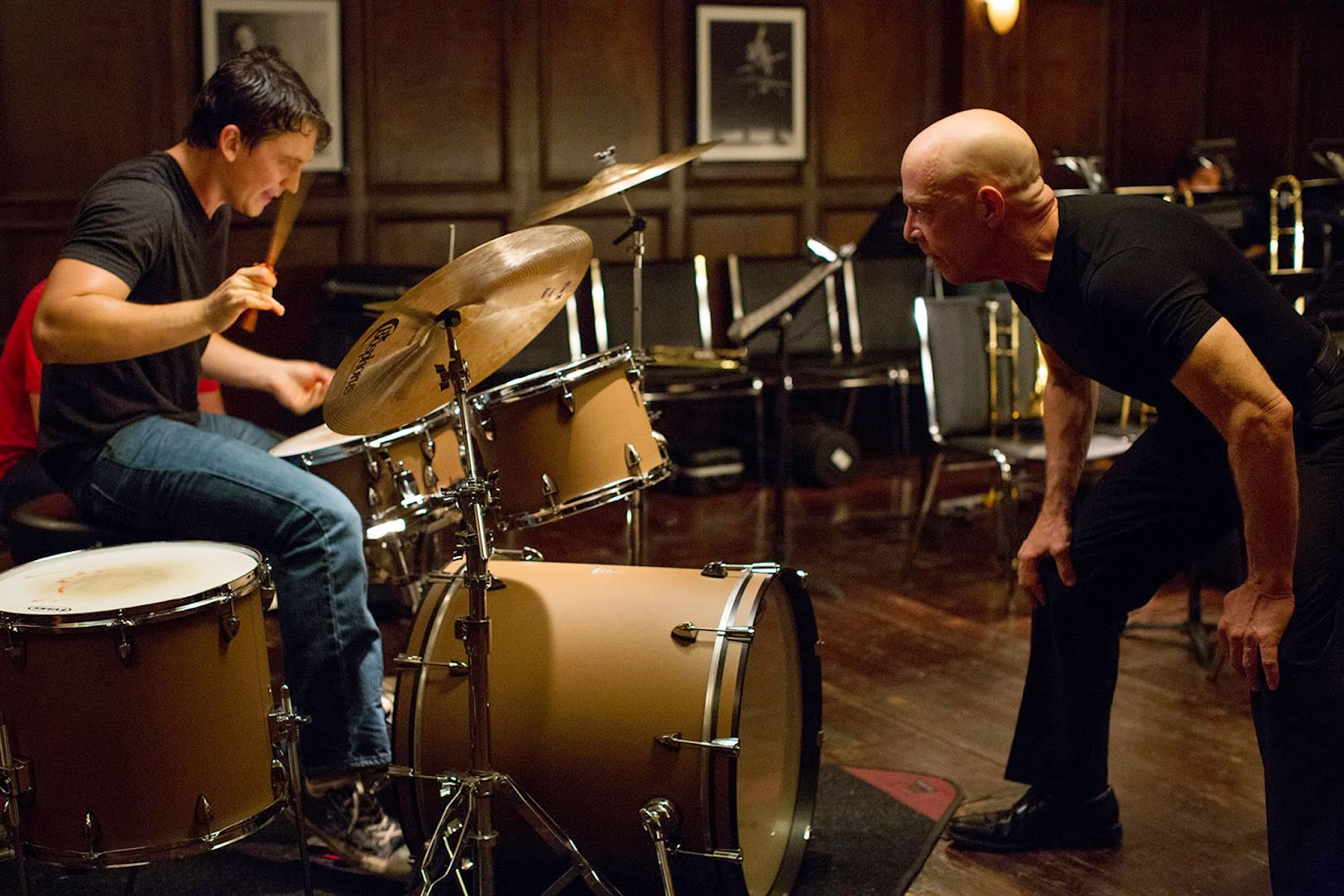
Whiplash arrived in Deauville with a considerable reputation, having dazzled critics in Cannes and Sundance (where it won the Grand Jury Prize). It received a similar reaction in Normandy: an impressive standing ovation and two awards. The hype does indeed not disappoint. Even if you don't like jazz, you can't help being swept away by the intensity and the brutality of the film and its incredible central performances by Miles Teller and J.K. Simmons. Damien Chazelle manages to get underneath the surface of blind ambition and the sheer will to succeed of both the young drummer Andrew and his teacher Terence Fletcher, who clash in an epic psychological battle. The audience never quite knows whether to laugh or to wince (usually ending up doing both at the same time) at the uncensored verbal abuse that J.K. Simmons hurls at his students in order to get the absolute maximum out of them. Everybody who has had a tough music teacher (or similarly a coach in sports) can relate to this story, which is told in an intelligent, unsentimental way. Whiplash builds tangible tension in an unstoppable crescendo, which finally collapses with a bang right before the end. Expect to hear more about this film come awards season.

1. Life Itself by Steve James


Picking my favourite film from Deauville was a very personal decision. I was always likely to feel affection for Life Itself, a documentary about the late Roger Ebert, one of my heroes. Since discovering an episode of his TV-show as a DVD extra on my copy of Pulp Fiction several years ago, the legendary critic has become an important part of my cinema education. I must have read hundreds of his reviews, every single one full of life and insight. His memoirs, which were a huge influence on the documentary, as Ebert passed away before filming was completed, provided an authentic glance into his personality. The film manages to do a similar thing in a very moving fashion. It is a sentimental, affectionate, tear-jerking, "American" celebration of Ebert's extraordinary life, but it is effective and, like its subject, it never feels dishonest or inauthentic. Steve James, best known for the Oscar-nominated basketball documentary Hoop Dreams, uses email correspondence, interviews with Ebert's wife, family and friends and passages from his book to craft this portrait, which had me in tears from beginning to end. The most upsetting moments are the scenes he shot of Ebert, who lost the ability to speak and eat ten years before his death (his chin and part of his face had to be removed due to severe cancer of the thyroid and salivary glands), in hospital during the final stages of his life. This sight is equally terrifying and inspiring. Everyone with an interest in film criticism should watch this film and learn from Roger Ebert.  


Wednesday, September 17, 2014

Deauville Top 10 part one: 10.-6.

10. Infinitely Polar Bear by Maya Forbes


Infinitely Polar Bear manages to avoid most of the pitfalls of films about a single father taking care of his children and makes up for its flaws with an overdose of warmth and charm. Mark Ruffalo stars opposite two superb child actresses as the bipolar former hippie Cameron. It is also nice to see Zoe Saldana play a human being for once as Ruffalo’s ambitious ex-wife, who leaves the kids in his custody. Writer-director Maya Forbes simply lets the cast do their thing and adds heart and excellent music to the film. There is a lot of screaming, swearing and chaos, but even more love, in this unconventional household, which quickly grows on the audience. Infinitely Polar Bear is a simple, fun movie, which doesn't attempt to lecture us about depression or parenthood. The sight of the incredible Hulk jumping around in red underwear and the hilarious “The Shining”-reference are worth the price of admission alone.

9. A Girl Walks Home Alone at Night by Ana Lily Amirpou


This Iranian vampire thriller was one of the most unusual and most interesting films to play at the festival. Read my full review of this one here.

8. It Follows by David Robert Mitchell


It Follows is in spirit a schlocky, camp B-movie, which could easily have been made by a young John Carpenter or Sam Raimi, with a hint of the post-modern self-awareness of Cabin in the Woods. The film opens on a scantily dressed teenage girl sprinting along a suburban street in complete terror, getting into a car and driving off to the beach. The next shot shows her blood-stained body in a stomach-turning pose. The cause of her death was by a mysterious power, which always follows its target in a walking pace. The only way to pass this curse on to another person is by having sex with them, which is precisely what happens to our young protagonist Jay (Maika Monroe) after she sleeps with her boyfriend. This simple premise is incredibly effective and the director has a lot of fun playing with our expectations and scaring us in unusual ways. The polished cinematography and stunning visuals (the director wanted to create a film that is simultaneously beautiful and disturbing) make It Follows one of the best horror films of the year.

7. Camp X-Ray by Peter Sattler


A film about the US-Army Guantanamo Bay detention camp was always going to stir many debates, but this film mostly avoids controversy while still making thought-provoking points. It pitches a young rookie-guard (Kristen Stewart once again proving her talent) against a well-educated, talkative detainee (A Separation’s Peyman Moaadi) in an intense psychological duel. The better part of the film’s running time consists of the mind games and the tentative steps toward friendship between the two, which are carried out through the small window of a firmly shut cell door. Their conversations start to raise doubts in the young soldier’s mind. Is the imprisonment of these people the right thing to do? Is the treatment of the detainees excessive? Is she actually one of the bad guys? There are obviously no clear cut answers to those contemplations and fortunately, the film doesn't try to give us any. This is a very good thriller with two excellent performances and it should be the origin of quite a few fascinating pub-discussions afterwards.

6. Love is Strange by Ira Sachs


John Lithgow and Alfred Molina as a devoted gay-couple in the latter stages of their lives – what else do you want? After spending four decades together, Ben and George finally get married in the film’s opening sequence. An extremely joyous occasion, celebrated with plenty of vine, songs and laughter, which soon has unfortunate consequences: George loses his job as a music teacher at a catholic school and they no longer can afford to keep their apartment. The temporary solution to this dilemma is a painful separation: Ben moves in with his nephew and his family, whereas George pitches his tent on the couch of his former neighbours, two gay policemen. What follows is an incredibly sweet portrait of these two people, who cannot cope apart. The movie could not be more New York if it tried (every character is a musician, artist, writer or filmmaker and there is A LOT of complaining about expensive rent-prices) and the story doesn’t really go anywhere, but there are some beautiful truths about love and companionship to be found in this story. You really enjoy spending time with these two. Loves isn’t strange, love is completely natural. 

Part two: here

Tuesday, February 18, 2014

Top 13 of ‘13: 1. Inside Llewyn Davis

image 
The most impressive thing about the Coen brothers these days is that they are seemingly effortlessly brilliant. Like Luis Suarez and nutmegs, they make filmmaking look straightforward and easy. Inside Llewyn Davis, their tale of the Greenwich Village folk scene of the early 1960s, slots in perfectly in their filmography, closest in tone to Barton Fink and The Man Who Wasn’t There.
The movie opens with a close-up of microphone in front of a dark background. A title has told us where we are: The Gaslight Café, 1961. Guitar music is playing and a male voice starts singing: “Hang me, oh hang me; I’ll be dead and gone…” Even before we see our protagonist, we know exactly where we are. It’s unusual to talk about the music first in a film review, but the soundtrack of Inside Llewyn Davis is not only brilliant, but also integral to the story. Most of the songs are performed live and in full length by the characters, almost making it a concert-movie of sorts. Enlisting the help of regular collaborator and music legend T-Bone Burnett, the Coens have assembled (there is only one original song) one of the best soundtracks in years.
The film tells the story of the failed (or rather failing) folk singer Llewyn Davis. After losing his singing partner, Llewyn is struggling to make it as a solo artist. Broke (he can’t even afford a winter coat) and homeless, he treks from couch to couch, until he runs out of friends and starts at the beginning. We are never sure whether Llewyn is a misunderstood musical genius or just a pretentious failure, but he sure thinks he is the former. He is rude, selfish and takes the charity of others for granted; yet somehow strangely likeable. Credit for this has to go to Oscar Isaac, who delivers a superb, understated acting and singing performance, completely embodying this character. He is never caught acting.
As usual with the Coens, an abundance of eccentric and funny supporting characters pop in and out of the story. Highlights include Justin Timberlake and Carey Mulligan playing the musician-couple Jim and Jean, John Goodman, who is finally reunited with the Coen brothers for a fifth time as the hilarious, drug addicted jazz musician Roland Turner, and a ginger cat which Llewyn chases through New York.
The structure of Inside Llewyn Davis puts an ironic, extremely coenesque twist on the classic road movie (there even is an actual road trip to Chicago in the middle of the film). Llewyn is constantly travelling from place to place, meeting different characters. Unlike Bruce Dern in Nebraska, Alexander Payne’s great road movie, Llewyn’s journey has no goal, and our hero keeps going around in circles, returning to where he has been before.  It’s the story of a loser who remains a loser.
While the story, when you think about it, is quite bleak, the tone is surprisingly warm and affectionate, not only due to the music, but also due to the characters. The dialogue is filled with an ever so slightly strange humour and wit, some of which you won’t notice the first time around, rewarding multiple viewings. The period is beautifully realised and cinematographer Bruno Delbonnel almost makes you forget that Roger Deakins was busy shooting Skyfall.
image
Making sense of it all may be difficult and if closure is what you’re looking for, you’re going to be disappointed. Asking more questions than it answers, Inside Llewyn Davis is an almost nihilistic, empty masterpiece, yet full of warmth and humour. It’s a film about how following your dreams might not always be the best idea, it’s a film about music, it’s a film about grief and responsibility; it’s simply a film you have to see.

Top 13 of ‘13: Special Mention: Stray Dogs

Before revealing my film of the year, I would like to mention a film I saw at the Venice Film Festival and which I haven’t stopped thinking about since: Ming-liang Tsai’s Stray Dogs. It hasn’t had a commercial release yet, which is why it isn’t on the regular list, but it deserves to be mentioned. Here is my review I wrote back in Venice: 
image
Ming-liang Tsai’s Stray Dogs, winner of this year’s Grand Jury Price, is not for everyone. In fact, it is not for most people. After the opening scene, a continuous shot of a woman brushing her hair while sitting next to two sleeping children which lasts for seven minutes, you know exactly where you are: cinema in its barest and purest form; almost closer to an art installation than a narrative film. The plot (it’s not as much a plot as very loose narrative linking the different images) depicts a father (Tsai regular Lee Kang-sheng) and his two children who live in Taipei. During the day, the father works as a human billboard, holding a sign next to a busy road while the children roam the streets of the city. There is little more to say about the story. Not much happens and we don’t learn much about the characters. Furthermore, the pace of the film is excruciatingly slow. There is little to no camera movement and the different scenes are extremely long (the entire 138 minute film contains about as many shots as a single scene in a Paul Greengrass film). 
It would be very easy to dismiss Stray Dogs as pretentious and boring or to lose patience with it (as indubitably many will). You keep waiting for something to happen, and it never does. Scenes have no causes or consequences, they just exist. We see the man eat a chicken, stand beside the road holding his billboard, we see the children wandering a supermarket getting free samples, we see a woman feeding stray dogs. This breaks every rule of fiction cinema and nothing seems to make any sense. If you go along with it however, Stray Dogs is anything but boring. It definitely is long, but it’s also mesmerizing and beautiful. It has a certain hypnotic quality to it: you don’t know what you are watching or why you are watching it, but the images are somehow fascinating. They burn themselves into the brain, and stay there for a long time after the end credits roll and everyone runs to the bathroom.
The acting is absolutely flawless in this. The actors are given very little to work with and all of them give wonderful minimalist performances. Lee Kang-sheng is arguably the stand-out. In one of the film’s most memorable scenes, he has to make a love-hate relationship with a cabbage (don’t ask) believable, similar to Tom Hanks and Wilson the volleyball in Cast Away; and he does so with unbelievable charisma and conviction.
Stray Dogs is a film that requires a lot of patience, but the rewards are infinite and the film will stay with you for a long time. Cinematic, beautiful and thought-provoking it is a piece of work for true film-lovers and perhaps the best I’ve seen in Venice.
image

Top 13 of ‘13: 2. Before Midnight

Before Midnight was by far the most anticipated sequel of 2013 within the art house community (even more so than The Smurfs 2!), reuniting director Richard Linklater and stars Julie Delply and Ethan Hawke after 9 years.  The formula from the first two instalments remains the same: it’s all about Céline and Jesse talking.
 After a mediocre opening scene between Jesse and his son from an earlier marriage, you are instantly back where Before Sunset left you. The incredible chemistry between Hawke and Delply (who are credited as co-writers) is still there and as strong as always.  We learn that after their second meeting in Paris, they got married and had twin girls, and that they are currently on holiday in Greece. Unlike the first two films, we meet other characters (friends whom they are staying with), albeit only shortly.
As we listen to Céline and Jesse, we realize that they are not the same people than they were nine years ago. They have matured (they’re 41 now) and have a different outlook on love, sex and life in general. They’re marriage is not perfect. Céline in particular doesn’t really seem happy about her professional life and wants to move to Paris, which would mean that Jesse would have to leave his son who lives in America. As they argue, jokingly at first, and then more and more intense, you feel their pain as they keep talking past each other. 
The most important thing about the film is that you completely believe in these characters (even if you may disagree with them or don’t like what they’re saying). The dialogue is extremely intelligent and carefully crafted, but at no point does it feel forced or unnatural. Linklater is very restrained in his direction, using long takes, in order to give the actors room to perform, and they deliver brilliantly.
Hawke and Delply form one of the best onscreen couples in film history andBefore Midnight is an intelligent and romantic (a combination you unfortunately don’t see too often) character study. Only nine years to go until Before 4; I’ll be the first in line.